Brazil
 American Latina
 France
 Germany
 Italy
 Portugal
 North America
 United Kingdom
 Finnish
 Norway
 Polish
 South Africa


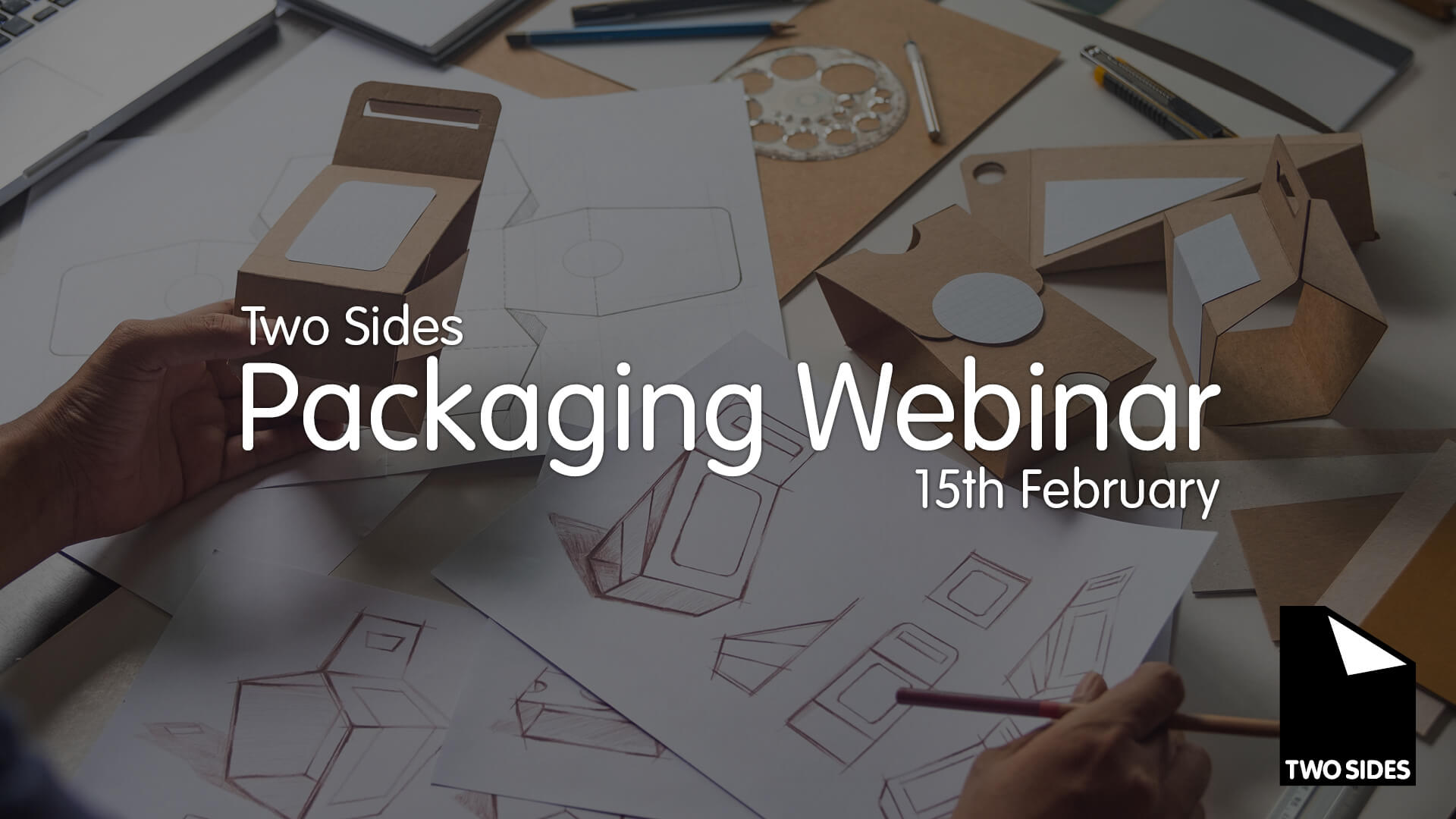
The first Two Sides Packaging Webinar brought together ten of Europe’s leading experts in packaging. Here are the highlights…
There’s little doubt that paper-based packaging is one of the hottest topics in the packaging industry right now. Whether it’s the increasing amount of plastic being swapped for paper and cardboard on the supermarket shelves, the continual success of e-commerce, or the design innovations boosting the brand experience, companies understand the power of paper-based packaging to support their sustainability values.
Reflecting this global interest, Two Sides created their first Packaging Webinar, which gathered ten experts to deliver key knowledge and insights into the sector, from the latest stats about the industry and design trends to top innovations and technology.
Industry Overview
Following an introduction to Two Sides and its work from Ian Bates, Partnership Director at Two Sides, Neil Osment provided a fascinating overview of the European corrugated and folding carton markets. The Managing Director of research company NOA showed the incredible rise and fall in corrugated demand across Europe over the past three years, with the more resilient output of folding carton holding up until the end of 2022.
The bright area for Neil is in the replacement of plastic with paper-based-packaging, with a significant uptick for the beer and soft drinks market, alongside cleaning and laundry, chilled and dairy. “Plastic replacement is a constant and consistent opportunity for the packaging industry,” he said. “So my rallying call to everybody is let’s go design and invent!”
The huge potential of paper-based packaging is something that was echoed by Tony Lock, the UK & Ireland Business Manager for HP. Tony delivered a rousing presentation extolling the virtues of digital printing, first stating that, according to Accenture, digital print reduces the world’s annual packaging waste by 30%. He then went through the latest trends in digital print and how they could change the fact of the packaging industry, namely smaller, on-demand print runs, personalisation, waste reduction, brand protection, the influence of young people all resulting in huge growth for digital print.
The Value Of Design
As someone with an MSc focusing on pulp and paper chemistry, it’s clear that Karl Axnäs, the Head of Service at Stora Enso, knows his stuff when it comes to paper-based packaging. His presentation concentrated on the company’s work in formed fibre solutions and their potential to replace single-use plastic. Currently working with a series of suppliers and customers, he states that this solid fibre-based packaging offers 60% less emissions than plastic, with 75% less machine downtime for cleaning compared to traditional tooling.
Following Karl, Dane Whitehurst, the Creative Director at Burgopak gave the online audience an insight into the design process of creating a piece of packaging, as well as the latest design trends. As one of the country’s most in-demand packaging companies, Dane has worked with some of the world’s top brands, such as Google, Samsung, Unilever, Sony, Chase and HSBC, so understands the importance of branding and innovation. “Our purpose is to translate and distill brand values into product experiences through packaging,” he explained. “We basically make really nice boxes that make people go wow.”
Along with sustainability, the huge influence of online unboxing videos has made packaging design a crucial area for brands. “People want beautiful things that make their lives better and enjoyable, but they also want society to take accountability for our planet,” said Dane. “I believe we’re moving closer to a time where sustainability is inextricably linked with the notion of good design.”
Scandi Solutions
For the final section of the seminar, the delegates were transported over the North Sea to Sweden, first to listen to Elin Furelid from The Absolut Company, then to Maja Kjellberg from IKEA.
As the Director of Future Packaging at The Absolut Company, Elin has a central role in driving innovation for Absolut Vodka, Sweden’s largest drink export. Present in over 100 markets globally, Absolut has a reputation for innovation and appealing to the younger generation, so it was perhaps no surprise when it announced it was trialling paper bottles.
While glass has a potentially infinite lifetime when recycled properly, paper offers a lower carbon footprint, a higher recycling rate and a light weight. “Our vision is for a 100% biobased paper bottle recyclable in the paper stream,” explained Elin.
Following trails of the paper bottle at a Swedish festival, a number of Tesco branches in Manchester, and currently a live trial in Sweden, the drinks brand is gathering information and feedback on the paper bottle. “We are finding that paper packaging isn’t seen as something new by consumers,” said Elin. “People also see paper as a nice material. They want to touch it, feel it, even kiss it.”
Finally, Maja Kjellberg, Packaging Development Leader at IKEA, explained the importance of paper-based packaging to the global furniture giant from both an operations perspective and sustainability. After reeling off a series of impressive stats (the company uses over a million tons of packaging a year across four billion packages and eight billion labels), she then delivered an update on IKEA’s work to replace plastic packaging with paper.
“We have gone from 70 million kilos of total plastic usage in 2020 to 40 million in 2023,” she said. “But we still need to minimise our plastic use even further, and our ambition is that IKEA should be plastic-free by 2028.”
To watch the recordings of the speaker presentations from the Two Sides Packaging Webinar, go to: twosides.info/packaging-webinar-2024