Brazil
 American Latina
 France
 Germany
 Italy
 Portugal
 North America
 United Kingdom
 Finnish
 Norway
 Polish
 South Africa
 Swedish
 Spanish
 Czech


The concept of Circular Economy was developed from an original idea in 2004, by the English sailor Ellen MacArthur. In 2010, the foundation that bears her name was created and tries to disseminate this proposal.
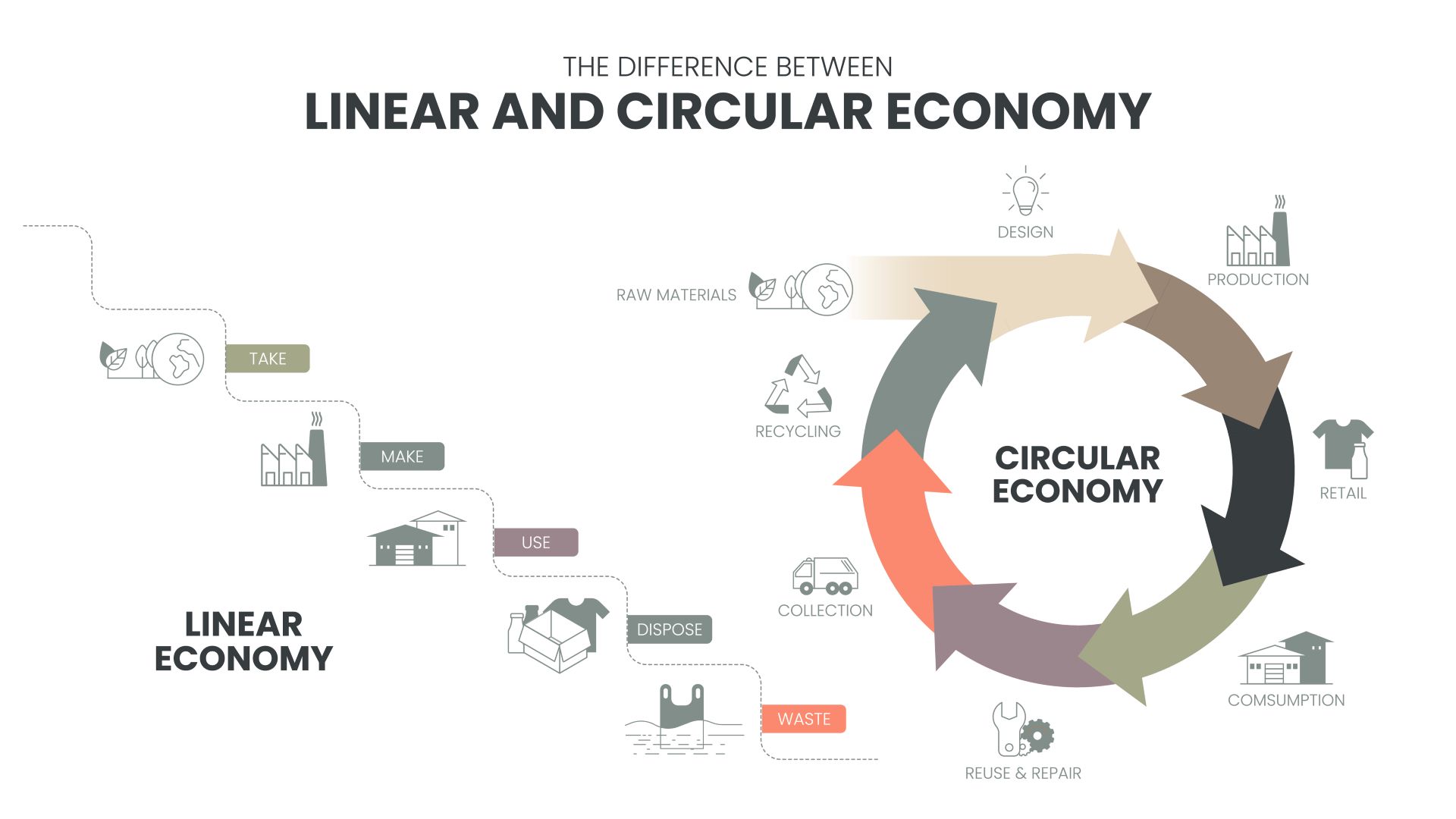
In the traditional mode of production and consumption, the destination of post-use goods is disposed of in dumps, landfills, incineration or the like. There is, of course, some level of recycling or reuse, but usually most of the resources used in the manufacture of the products – energy, inputs, working hours, logistics, etc., end up being lost in some way. Obviously, this model is terrible for the environment, both because of the damage caused by extractivism (the removal of natural resources particularly for export with minimal processing) – often necessary to obtain raw materials – and because of the waste of resources and the consequent pollution.
The Circular Economy proposes a radical change in this model – first, products must be designed already planning their reuse, so that they are never definitively discarded. Secondly, if reuse is not possible, the “circular design” must ensure that the product is fully (and easily) recyclable. The life cycle of this type of product will be circular and will not have an end – hence the expression “cradle to cradle”, replacing the formula of “cradle to grave”. If the Circular Economy is fully implemented, there will be no more garbage, just as there is no garbage in nature.
But the Circular Economy also proposes the use of renewable energy sources, the fight against climate change, the elimination of toxic waste from industrial processing, the protection and promotion of biodiversity and the regeneration of ecosystems in the process of degradation. The objective is to reconcile economic development with environmental sustainability.
Many major companies believe in this concept and are investing heavily in processes and technologies that can realize it. The great news is that the pulp and paper sector is already very advanced in this regard. Its raw material is renewable – trees grown systematically. This cultivation recovers soils that were at different levels of degradation. Cultivated trees sequester carbon from the atmosphere. Paper is already widely recycled and is biodegradable. Paper books are examples of reuse. Waste from industrial processes is strictly controlled.
New developments are being developed to further improve the pulp and paper sector’s adherence to the Circular Economy. But it is also up to designers, printers and converters to move in this direction, taking advantage of the great environmental advantages of cellulosic substrates.
Designers are responsible for designing graphic products that can be reused and looking for embellishment alternatives that do not require paints, varnishes or laminations that make recycling or biodegradation difficult.
Printers and converters need to identify and quantify their environmental footprints, reduce them as much as possible, and compensate for negative impacts that cannot be eliminated. In the packaging sector, there are already “ecological” barriers that can replace, in many cases, synthetic polymers.
Two Sides supports and encourages initiatives that help close this virtuous cycle.
To learn more:
www.ellenmacarthurfoundation.org
Book: “Cradle to Cradle – create and recycle unlimitedly”. Michael Braungart and William McDonough. Publisher Gustavo Gili Brasil, 2013.