ANZ
 Brazil
 American Latina
 France
 Germany
 Italy
 Portugal
 Nordics
 North America
 South Africa
 United Kingdom



As we enter the new year, we ask a panel of industry experts what the next 12 months has in store for the print and packaging sectors
Phil Rickets,
Commercial Director, Marketreach
2025 is set to be a pivotal year for innovation in print and direct mail, with sustainability and impact taking centre stage. There are four key highlights:
The launch of PrintGreen will bridge the gap between industry data and brand decision-making, establishing print as a genuine circular medium. At Marketreach, we empower advertisers to make sustainable choices, and PrintGreen will make real waves.
The JICMAIL-Origin partnership will further cement mail’s position as a measurable, impactful marketing channel. By bringing mail metrics into Origin’s cross-media platform, advertisers will gain clearer insights into how mail drives multi-channel success. Early results in 2025 could strengthen its place as the third-largest advertising medium in the UK.
There are other reforms in 2025, such as the new Smart Data Bill, which will make direct mail more attractive as a medium, addressing the historical barriers created when GDPR was introduced. This is especially useful, with marketers having to become increasingly creative to reach audiences within budgets.
And let’s not overlook the massive potential for mail within retail media. With personalised dynamic creative landing directly on doorsteps, 2025 could be the year mail reclaims its title as the original retail media channel.
Rachel Aldighieri,
Managing Director, Data & Marketing Association (DMA)
2025 is going to be the year when marketers have to get to grips with the crisis in performance marketing effectiveness and ask themselves whether increased CPAs and declining response rates are just about the economic climate or whether they could be doing anything better on the home front.
Improved creativity, applied measurement best practice, and testing and learning with marketing spend are all areas that will optimise performance and help marketers defend and grow their budgets.
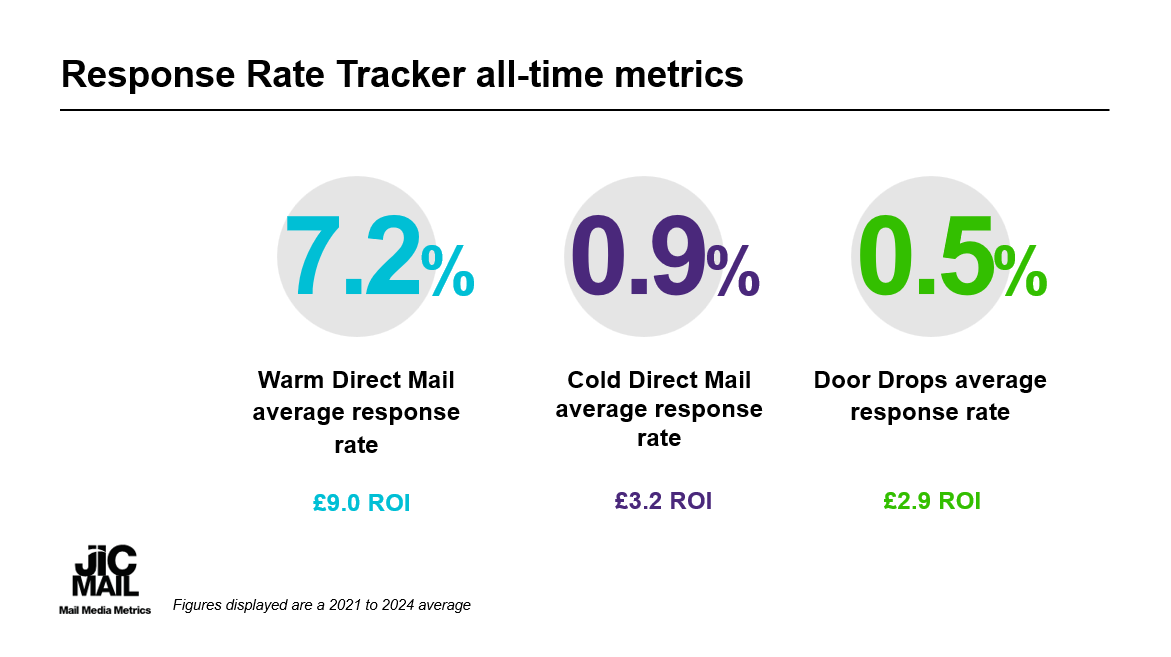
So what does this mean for print? JICMAIL data tells us that while performance marketing effectiveness might be in decline, effectiveness in the mail channel is holding up well, with ROI ranging from £2.60 to £9 depending on the channel (direct mail or door drop) and who you are targeting (new or existing customers).
Combined with the DMA’s Value of Creativity report telling us through an analysis of 1,500-plus campaigns that tactile channels drive more response effects than any other channel, it’s very much time for the print industry to re-assert its credentials in the effectiveness debate in 2025.
Mathew Faulkner,
Director, Marketing & Innovation, Wide Format Printing Group Canon EMEA
We recently spoke to four prominent futurists from outside the print community for our 2025 Canon Insight Report to hear their ideas about broad trends that are shaping the future of print. Several elements cut across all conversations. Notably, consumer behaviours are changing in that old brand allegiances are eroded by new ways of browsing and buying, and younger generations are choosing brands based on shared values as an extension
of their identity.
This challenges classic marketing practices and forces marketers to think about more nuanced and individualised ways of reaching target audiences, creating value from the customer data they hold.
This plays to the unique advantages of intelligently personalised print, whether
that’s targeted direct mail or a piece of primary packaging. Print is a highly effective medium for achieving impact, tapping into consumer emotions and building long-term loyalty and brand advocacy.
More food for thought came from the observation that our world has become increasingly virtual, with exponential levels of growth in the amount of time we spend on digital platforms.
This causes us to seek out and interact more intensely with physical experiences, whether that’s in a retail environment or unboxing a product. For the digitally overwhelmed, this makes print a powerful ‘attention gateway’ – more so if the piece of print is special or boosts the recipient’s sense of their own worth.
In 2025, the key opportunity for print businesses will come from thinking creatively about buyers’ commercial challenges, then channelling digital production capabilities to offer solutions that blend insight and imagination to control audience attention.
Eleni Despotou,
Director General, FEFCO
As we begin the first few weeks of 2025, the last 12 months have been rich in activity to cope with the challenges of EU legislation, but also by geopolitical and economic challenges. The month of December was marked by the long-awaited adoption of the Packaging and Packaging Waste Regulation (PPWR). This determines how all packaging industry actors will operate in the future, and brings challenges as well as opportunities.
While the sustainable, renewable and recyclable character of corrugated packaging has been recognised, challenges may be posed during the second phase of legislation, notably in design for recycling, harmonised labelling, empty space ratio and the minimisation of packaging.
The EU Deforestation Regulation (EUDR) could also create issues for the paper and board value chain. The regulation aims to ensure that key products traded and consumed in the EU and globally don’t contribute to deforestation and forest degradation.
Corrugated cardboard packaging will continue to play a vital role in Europe’s logistics network, facilitating the safe and efficient transport of goods across key sectors. It’s a perfectly ‘circular by nature’ product, with an impressive 88% recycled content rate, and the most recycled fibre-based packaging material in the EU. It also supports the circular economy by preserving valuable resources and fostering a thriving secondary raw materials market.
Beatrice Klose,
Secretary General, Intergraf
For the graphic industry, 2025 will be influenced by emerging regulations, AI and evolving market demands. The delayed implementation of the EU Deforestation Regulation provides valuable time for companies in the forest-based value chain to adapt their procedures. Intergraf will support this transition with the publication of a guidance document in early 2025.
Simultaneously, the Packaging and Packaging Waste Regulation (PPWR) will reshape how products are packed, requiring packaging printers to adopt greater flexibility to meet the needs of brand owners, e-commerce and other businesses in this sector.
As digital-first approaches gain momentum, Intergraf remains steadfast in defending the role of print – in particular, advocating for the preservation of printed medical leaflets during the review of EU pharmaceutical legislation.
Technology will also continue to transform the industry, with AI expected to play a growing role in automation, forecasting and enhancing efficiency within print companies across Europe.
At Intergraf, we will continue to raise the profile of print by communicating the medium’s advantages and promoting the sector to younger generations. Together, we aim to ensure that print remains an innovative and sustainable industry.